Fish Profiles
Angelfish care guide: tank size, tankmates and territory
Angelfish care beyond the pretty photos: real adult size, the tall tank they need, water parameters, feeding, and which tankmates actually work.
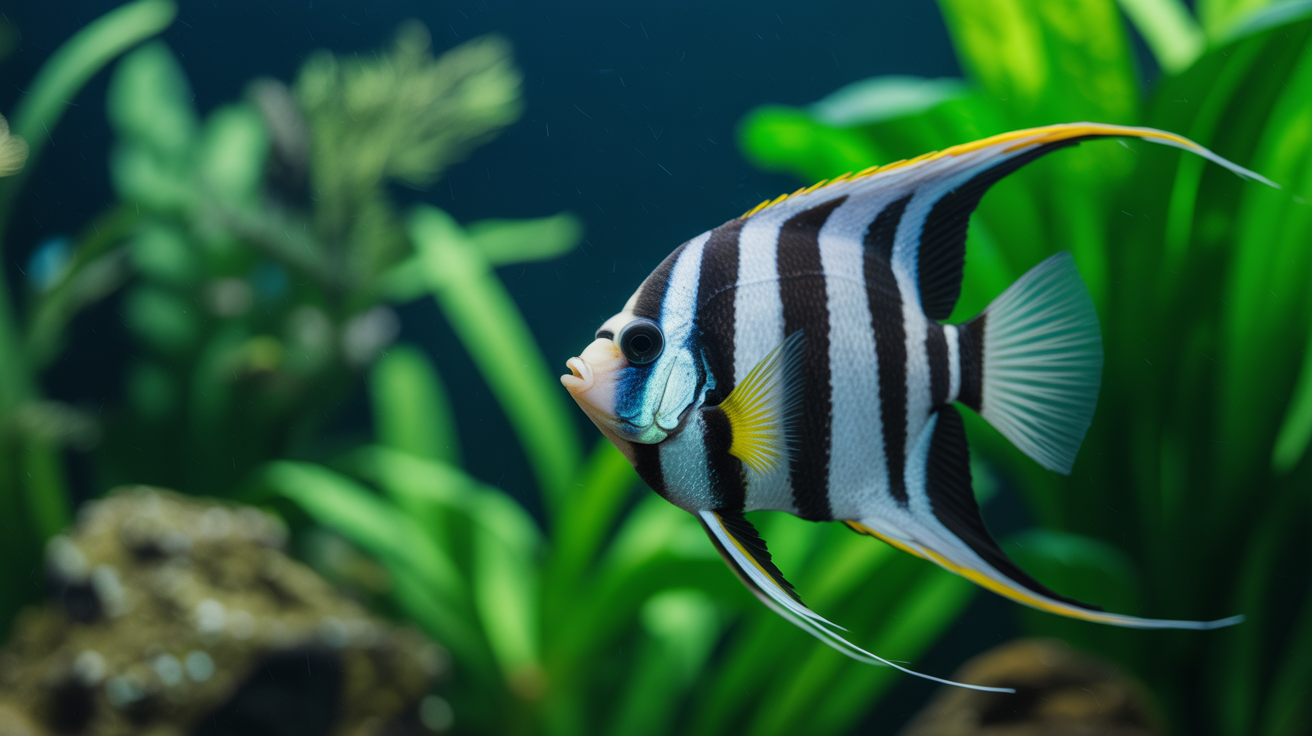
A juvenile angelfish at the store is a dime-sized, silvery little thing gliding around a bare tank, and it is easy to picture it fitting neatly into whatever community setup you already have. That picture is misleading. Good angelfish care means planning for an animal that will roughly triple in height, stake out a corner of the tank as its own, and possibly turn from a peaceful schooler into a short-tempered homeowner once it pairs up. None of that makes angelfish a bad choice. It just means the fish you buy is not the fish you will be keeping in a year.
This guide covers the tank size and shape angelfish need to grow properly, the water conditions they do best in, how their temperament shifts with age and pairing, and which tankmates hold up over the long run.
Angelfish tank size: why height matters more than gallons
Angelfish are cichlids, and like most cichlids they get bigger and more opinionated than their baby-fish appearance suggests. A full-grown angelfish typically reaches 6 inches or more in body length, and because their dorsal and anal fins extend well beyond that, their vertical profile is often closer to 10 to 12 inches from fin tip to fin tip. That fact should drive your tank choice.
A standard 20-gallon long tank is only about 12 inches tall, barely enough clearance for one adult to turn around, let alone a pair defending a breeding site. Look instead for tanks in the 18-inch-tall range and up. A 29-gallon tank works for a single fish or a bonded pair, but most experienced keepers treat 40 gallons as the realistic minimum for a small group of five or six juveniles you plan to grow out and let pair off naturally, since angelfish do best raised in a group rather than bought as an already-matched pair.
Footprint matters too, just less than height. Angelfish are not fast swimmers, but they patrol a defined territory once mature, and a long, narrow tank gives a breeding pair more room to divide themselves from tankmates than a tall, narrow one does. If you are still deciding on your first setup, our guide on what size aquarium a beginner should get walks through footprint versus volume in more general terms, and it is worth reading before you commit to glass.
Décor and vertical space
Angelfish evolved moving through flooded, root-tangled Amazonian habitat, so they are happiest with tall plants, driftwood branches, or artificial equivalents that give vertical cover rather than just horizontal hiding spots. Broad-leafed plants like Amazon sword or large Anubias also double as the flat surfaces a breeding pair will eventually choose for eggs. If you are planning the layout from scratch, our piece on aquascaping basics for hardscape and layout covers breaking sightlines with rock and wood, which genuinely helps here since visual barriers reduce how often an adult angelfish feels it needs to chase off a rival.
Water parameters angelfish need to thrive
Angelfish are more forgiving than their reputation suggests, but they do best within a fairly specific range, and stability matters more than hitting an exact number.
- Temperature: 78 to 84°F. They tolerate the low 70s briefly but grow slower and get sick more easily if kept consistently cool.
- pH: 6.5 to 7.5 suits tank-raised angelfish, which make up the vast majority sold today. Wild-caught or altum angelfish want it softer and more acidic, but that is a specialist fish, not a beginner one.
- Hardness: soft to moderately hard water is fine. Extremely hard, high-mineral tap water can work against long-term health and breeding success even when the fish survive it.
- Ammonia and nitrite: zero, always. Angelfish are vulnerable during an uncycled startup like any fish, so do not add them to a brand-new tank in its first few weeks.
- Nitrate: keep it under 20 ppm with regular water changes. Angelfish tolerate higher nitrate without dropping dead, but their color and fin condition noticeably improve in cleaner water.
Feed a quality flake or pellet as a base, supplemented with frozen or live foods like bloodworms and brine shrimp a couple of times a week. Angelfish have upturned mouths built for picking food out of the water column, so they compete poorly against fast bottom feeders for sinking food; make sure some of what you feed reaches mid-water where angelfish naturally hover.
Territory and aggression: the personality shift nobody warns you about
This is the part that catches new keepers off guard. A young angelfish, especially one raised in a group of five or six, is genuinely peaceful and often a little shy. It schools loosely with its siblings and rarely bothers anything else in the tank. That fish is not lying to you, but it is not done changing.
Somewhere around six months to a year old, angelfish reach sexual maturity, and that is usually when the personality shift shows up. Fish that were interchangeable tankmates sort themselves into a pecking order, and eventually some pair off. Once a pair bonds, and especially once it claims a breeding site, the pair can become genuinely territorial: chasing other angelfish away from a chosen corner, flaring at anything that swims too close, and occasionally roughing up tankmates that used to be ignored. This is normal cichlid behavior, not a sign something is wrong with your fish, and it is exactly why raising a group beats buying two angelfish and hoping they get along, since a group lets pairs form naturally while unpaired fish still have room to get out of the way.
Breaking sightlines with plants and wood, as mentioned above, reduces how often a dominant pair feels the need to assert itself, since fish that cannot constantly see a rival are less likely to constantly chase it.
Choosing angelfish tankmates that actually hold up
The trick with tankmates is picking fish big enough not to look like food, calm enough not to trigger chasing, and not so fin-nippy that they shred an angelfish's flowing fins. Angelfish move slowly with trailing fins, making them an easy target for any nipper.
| Good tankmate options | Why they work | Species to avoid |
|---|---|---|
| Corydoras catfish | Calm bottom dwellers, ignore territory disputes at the surface | Tiger barbs |
| Bristlenose pleco | Peaceful algae eater, mostly nocturnal | Serpae tetras |
| Rosy or lemon tetras | Large enough not to read as prey | Neon tetras (adult-sized concern) |
| Dwarf gourami | Similar temperament and pace | Fin-nipping barbs generally |
| Bolivian rams | Mellow cichlid that shares the water column well | Aggressive cichlids (convicts, jaguars) |
A word on neon tetras specifically, since it is a pairing people ask about constantly: neon tetras and juvenile angelfish coexist fine, and it is a classic community combination early on. The problem shows up later. Once angelfish reach adult size, a neon tetra is roughly the size of the small fish angelfish eat in the wild, and it is not unusual for an adult to start picking them off one at a time. If you want both long term, either accept some attrition as the angelfish grows, or plan to rehome the tetras first. Our guide to neon tetra care and ideal tankmates covers this pairing in more depth from the tetra side.
If this is your first tank altogether, it is worth reading our roundup of the best beginner fish for a first freshwater aquarium before settling on angelfish as your centerpiece, since they are a step up in space and patience from the true beginner species on that list.
Breeding pairs: what changes once angelfish find a mate
If you keep a group long enough, two will likely pair off on their own, recognizable by the pair spending most of their time together, defending a shared patch of tank, and cleaning off a flat leaf or slate surface in preparation for eggs. Once that happens, expect the tank's dynamic to shift. The pair becomes the dominant presence, other angelfish get pushed to the edges or need rehoming, and the pair's tolerance for tankmates drops, at least right around their spawning site.
This is a normal, healthy stage, not a problem to fix, but it is worth planning for before it happens. A tank long enough for a pair to claim one end while other fish keep comfortable space at the other causes far less stress, for you and for the fish, than a tank with nowhere else to go.
Frequently Asked Questions
How big of a tank does a single angelfish need?
A single adult can live comfortably in a 29-gallon tank at least 18 inches tall, though more length is always appreciated. If you plan to keep a group and let a pair form naturally, budget for 40 gallons or more.
Can angelfish live with other angelfish?
Yes. Raising a group of five or six juveniles together is the recommended way to end up with a compatible breeding pair, since they sort out their own hierarchy. Expect some chasing and posturing as they mature, and give unpaired fish room to keep their distance.
Do angelfish need a heater?
Yes. Angelfish are tropical fish that need stable water in the 78 to 84°F range, and unheated room-temperature water in most climates runs too cool for consistent health and growth.
Will angelfish eat small tankmates?
They can, once they reach adult size. Fish in the neon tetra size range are the most common casualties, since a full-grown angelfish can easily eat something that small. Choosing tankmates that stay proportionally larger avoids this problem.
How can I tell if two angelfish have paired up?
A bonded pair typically swims together, defends a shared area against other tankmates, and can often be seen cleaning a flat leaf or a piece of slate in preparation for spawning. If two fish in your group start doing this while the others keep their distance, you likely have a pair.