Tank Setup
Where to Put a Fish Tank for Light, Noise and Floor Weight
Where to put a fish tank: sunlight, algae, noise, temperature swings, outlet access, and floor weight, with a do this/avoid this checklist.
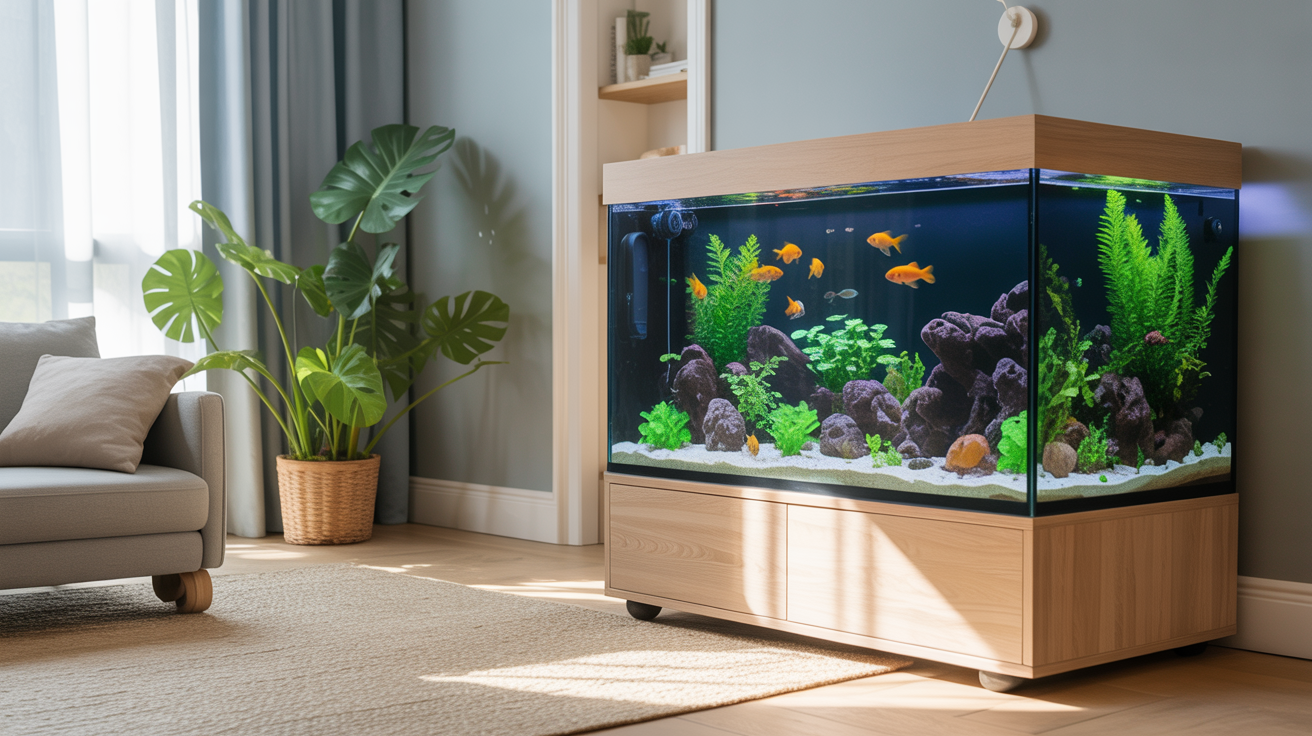
Before you fill a single bucket, figure out where to put a fish tank. It sounds minor compared to picking fish or a filter, but a bad spot causes more headaches than almost anything else in the hobby: green water within a week, a stressed-out school of tetras that won't leave the driftwood, or a stand creaking under a weight nobody checked. Spend twenty minutes walking your house before you buy anything, and most of that disappears.
This isn't about finding the "perfect" room. Most homes don't have one. It's about ranking your available spots against what actually matters and picking the least-bad option.
Keep it away from direct sunlight
A window looks like a natural fit for a fish tank. It isn't. Direct sun hitting the glass for even a couple of hours a day turns an aquarium into a greenhouse for algae. You'll notice it first as a green tint in the water, then as a fuzzy coating on the glass that reappears within days of you scraping it off. Once a tank tips into that cycle, fighting it becomes a permanent part of your maintenance routine instead of an occasional one.
Sunlight also drives temperature swings. Glass and water both hold heat, so a tank baking in afternoon sun can climb several degrees above where your heater is set, then drop again overnight. Fish tolerate a stable temperature far better than a swinging one, even if the swing looks small on paper.
You don't need a windowless room. A tank set back from a window, or against a wall on the shaded side of the room, is usually enough. If a window is your only real option, blackout curtains or a blind kept mostly closed during peak sun hours does most of the work.
Noise and vibration stress fish more than people expect
Fish don't have eyelids, but they do have a lateral line that picks up vibration in the water, and thumping bass, a slammed door, or a subwoofer against a shared wall all travel through a stand and into the glass. A tank near a home theater setup, a laundry room, or a kid's play area with a lot of running and door-slamming isn't a dealbreaker, but weigh it against quieter alternatives if you have them.
The symptoms of chronic noise stress are subtle: fish hiding more than usual, faded color, skittish darting when nothing else has changed. It's easy to blame water quality or a new tankmate when the real issue is a speaker cabinet two feet away. A rug or rubber mat under the stand helps more than people expect if a quieter spot isn't available.
A quiet corner of a living room or a bedroom that isn't a thoroughfare for the household tends to work well. It's calm for the fish, and calm for you when you actually want to sit and watch the tank.
Watch for heating vents and drafty windows
Beyond direct sun, watch for anything that changes the air temperature right around the tank. A forced-air heating vent blowing warm air across the glass, an old window with a winter draft, or a spot next to an exterior door all create localized swings that a heater has to constantly fight. It'll usually keep up, but it works harder than it needs to, and any gap in that fight (a power blip, a stuck thermostat) shows up faster in a tank already fighting the room.
Interior walls, away from exterior doors and windows, hold a steadier ambient temperature. It's a small thing, but it's free, and it makes the equipment's job easier for the life of the tank.
Plan for outlets before you plan for furniture
A tank needs at least a heater and a filter running at all times, plus a light on a timer, and often an air pump too. That's several devices pulling from one spot, so you want a grounded outlet nearby, ideally on its own circuit rather than shared with a space heater or a hair dryer that might trip a breaker.
A drip loop (letting the cord dip down before it climbs back up to the outlet) keeps water running down a cord from reaching the outlet itself. It takes thirty seconds and it's one of those things you only regret skipping once. If your ideal light-and-noise spot is nowhere near an outlet, a properly rated extension cord is a workable stopgap, but running one across a walkway people trip over isn't.
Floor weight is the one people skip
This is the part beginners most often overlook, and it carries the highest cost if you get it wrong. A full aquarium is heavy. Water alone weighs close to 10 pounds per gallon once you add gravel, rock, and glass, and that climbs a bit more once everything is filled and settled. A 20-gallon tank is a manageable weight almost anywhere. A 55-gallon or 75-gallon tank starts to look more like a piece of furniture needing real structural thought, especially past the 40-gallon mark.
Ground-floor rooms over a slab or well-supported joists handle even a large tank without special reinforcement, since the load path goes straight down. Upstairs rooms and apartments are different: the floor spans a room below it, and a tank centered in that span concentrates weight into a small footprint. It won't collapse the day you fill it, but a heavy point load over time can cause sagging, cracked drywall below, or a noticeable bounce, none of which are cheap to fix.
The practical fix: position a larger tank along a wall, ideally near a floor joist or load-bearing wall below, rather than the center of a room. A stand rated for the tank's full filled weight (not the dry weight of the tank alone) spreads the load across its footprint properly. If you're unsure what an older house or a second-story room can handle, ask someone who actually knows the structure rather than guessing.
If you rent, check with your landlord before putting anything sizeable upstairs. A lease silent on aquariums doesn't mean nothing applies, and water damage from a cracked tank or an overloaded floor is exactly what a landlord cares about after the fact.
Still deciding how big to go? Working backward from your room's floor and wall space is a good way to land on what size aquarium a beginner should actually get before falling for a tank that won't fit anywhere sensible.
A do this, avoid this checklist
| Do this | Avoid this |
|---|---|
| Place the tank against an interior wall, away from direct sun | A spot right in front of a south- or west-facing window |
| Choose a stand rated for the tank's full filled weight | Reusing furniture never built to hold hundreds of pounds |
| Keep the tank near a dedicated, grounded outlet | Running multiple space heaters off the same circuit |
| Position larger tanks along a wall near floor support | Centering a 55-gallon-plus tank in the middle of an upstairs room |
| Check with a landlord before a large upstairs tank | Assuming a lease's silence on aquariums means no rules apply |
| Use a drip loop on every cord running to an outlet | Letting cords rest in a puddle from a splash or a top-off |
Where to put a fish tank when no room is perfect
No room hits every mark perfectly. If you have to choose, prioritize floor support and outlet access first, since those create real problems (a sagging floor, a tripped breaker at 2 a.m.) rather than just extra maintenance. Sunlight and noise are things you manage around with a curtain, a rug, or a slightly less ideal but livable spot.
Once you've settled on a location, the rest falls into place faster. Our step-by-step guide to setting up your first freshwater aquarium walks through what comes next, and our rundown of essential equipment for beginners covers what you'll be plugging into that outlet. Once the tank is sitting where it belongs, our guide to aquascaping basics, hardscape layout, and focal points is a good next stop.
Frequently Asked Questions
Can I put a fish tank near a window if it gets morning sun only?
Morning sun is easier to manage than afternoon sun since it's weaker and shorter, but it can still feed algae over time. A sheer curtain or blind for that hour or two usually keeps it in check. Watch the glass for the first sign of green film and adjust from there.
How much does a full 40-gallon tank actually weigh?
Water alone runs close to 10 pounds per gallon, so a 40-gallon tank holds roughly 400 pounds of water before gravel, rock, the glass, and the stand. That's why floor support and a properly rated stand matter more as tank size increases.
Is a bedroom a bad spot for a fish tank?
Not at all, as long as the filter and air pump noise (usually a low hum) won't bother your sleep, and there's an accessible outlet. Bedrooms are often quieter and darker than living rooms, which works in your favor on both counts.
Do I need to reinforce the floor for a 20-gallon tank?
Almost never. Even filled, it weighs little enough that a normal residential floor handles it on any level of the house. Reinforcement becomes a real question mainly for tanks in the 55-gallon range and up, particularly upstairs.
What if the only outlet near my ideal spot is already crowded?
A dedicated power strip is usually fine for a heater, filter, and light, but keep it off a circuit shared with high-draw appliances like a space heater that could trip a breaker. If you're regularly worried about the circuit, have an electrician take a look rather than guessing.