Tank Setup
How to Set Up Your First Freshwater Aquarium, Step by Step
Learn how to set up a freshwater aquarium the right way: from choosing a tank size and gear to cycling the water before your first fish.
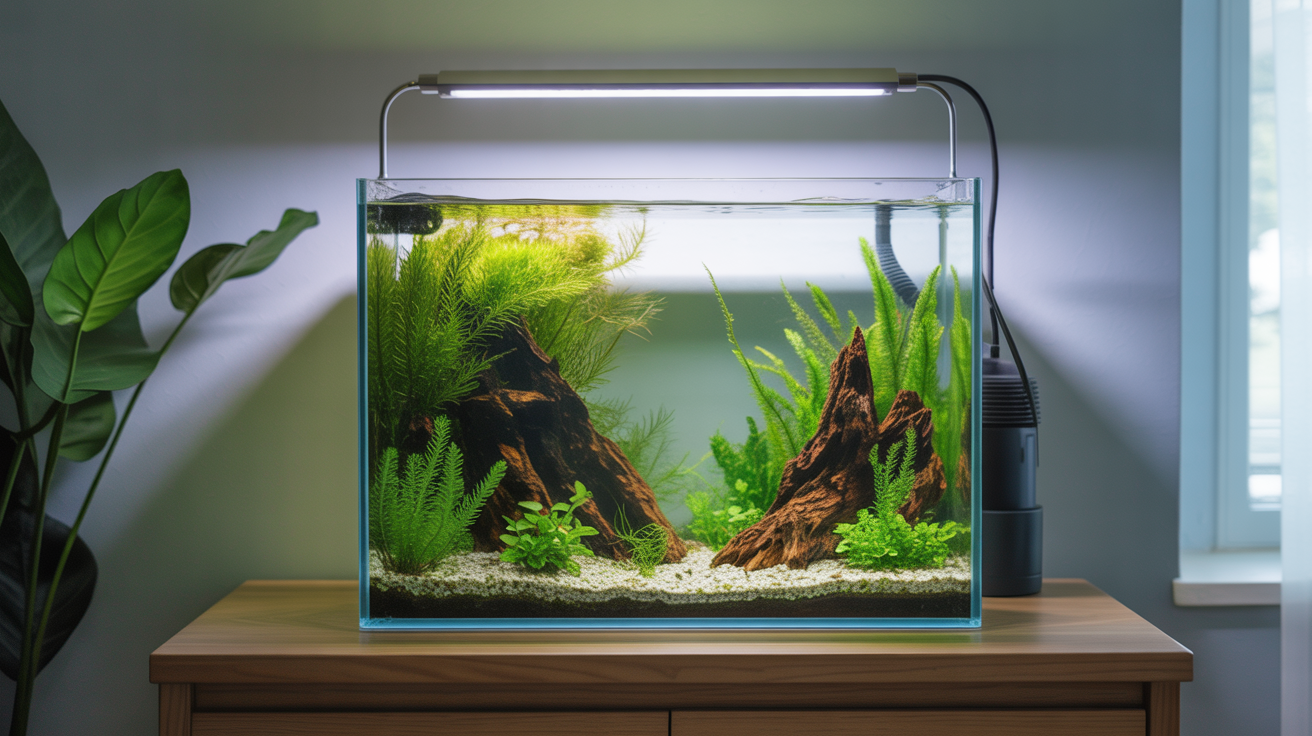
Setting up a freshwater aquarium is straightforward once you understand the sequence. The most common mistake beginners make is adding fish on day one, and that almost always ends in dead fish and frustration. Follow the steps below, give the tank a few weeks to stabilize, and you'll have a healthy setup that lasts for years.
Step 1: Choose the Right Tank Size
Bigger tanks are actually easier to maintain than small ones. A 20-gallon (76-liter) long tank is the sweet spot for most beginners: it holds enough water that small temperature and chemistry swings don't spiral into crises, but it's not so large that the monthly water change feels like a chore.
Ten-gallon tanks are sold as "starter kits" constantly, but they're genuinely harder to manage. Ammonia spikes faster, temperature fluctuates more, and stocking options are limited. If budget allows, start at 20 gallons. If you're set on a smaller tank, read our guide on what size aquarium a beginner should get before committing.
A useful rule of thumb when comparing options:
| Tank size | Water volume (approx.) | Maintenance difficulty | Good beginner choice? |
|---|---|---|---|
| 5 gallon | 19 L | High | No (betta-only with experience) |
| 10 gallon | 38 L | Moderate–high | Marginal |
| 20 gallon long | 76 L | Moderate | Yes |
| 29 gallon | 110 L | Moderate | Yes |
| 40 gallon breeder | 151 L | Low–moderate | Yes, if you have the space |
Step 2: Gather Your Equipment Before You Fill Anything
Get all your gear sorted before a drop of water goes in the tank. You'll need:
- Filter: rated for at least the tank's volume, ideally 1.5 to 2 times over. A hang-on-back (HOB) or canister filter works well for most beginner setups.
- Heater: sized in watts to the tank volume. A general guide is 3–5 watts per gallon. For a 20-gallon tank, a 75-watt adjustable heater is reliable.
- Thermometer: a simple stick-on thermometer is fine, though a digital probe is more accurate.
- Substrate: plain aquarium gravel or sand, rinsed thoroughly before use.
- Lighting: most beginner tanks include a basic LED hood; if you plan on live plants, you'll need a higher-output light rated for planted tanks.
- Dechlorinator: a water conditioner (sodium thiosulfate-based) that neutralizes chlorine and chloramine in tap water. This is non-negotiable. Chlorine will kill your beneficial bacteria and stress your fish.
- API Master Test Kit (or equivalent liquid test kit): test strips are notoriously inaccurate; liquid kits give you real numbers.
- Fishnet, bucket, and siphon gravel vacuum: for water changes.
You don't need a CO2 system, fancy dosing pumps, or a UV sterilizer at this stage. Keep it simple.
Step 3: Rinse Everything and Aquascape
Rinse your gravel or sand in a bucket under running water until the water runs clear. It usually takes 5 to 10 minutes of stirring. Skip this step and you'll spend weeks looking at a murky tank.
Lay substrate 2–3 inches (5–7 cm) deep. Deeper substrate suits planted tanks; shallower works for fish-only setups.
Place any décor (driftwood, rocks, ceramic caves) before filling with water. Think about line-of-sight breaks and hiding spots. Fish that have places to retreat are less stressed and display better color. Driftwood can leach tannins that tint the water amber; this is harmless but some people don't like the look. Soaking driftwood in a bucket for a few days before adding it to the tank helps reduce the tint.
If you're using live plants, add them after filling the tank with a few inches of water.
Step 4: Fill the Tank and Set Up Equipment
Set the tank on a sturdy, level surface that can hold the weight. Water weighs about 8.3 lbs per gallon (1 kg per liter), so a filled 20-gallon tank is roughly 170 lbs (77 kg) with substrate and glass.
Fill with tap water, then add dechlorinator according to its label (usually 1 ml per 10 gallons). Install the heater according to its instructions and set it to 76–78°F (24–26°C) as a safe starting point for most tropical community fish. Give it 30 minutes before plugging in; this lets the heater acclimate to the water temperature and prevents thermal shock to the heating element.
Mount the filter and get it running. Turn on the light on a consistent schedule: 8–10 hours per day keeps algae manageable and is enough for most low-demand plants.
Step 5: Cycle the Tank (The Most Important Step)
This is the part most beginners skip, and it's why so many first tanks fail within weeks.
Before fish can live safely in a tank, you need to establish a colony of beneficial bacteria that convert toxic ammonia (fish waste) into nitrite, then into the much less harmful nitrate. This process is called the nitrogen cycle and typically takes 4–6 weeks in a brand-new tank. For a thorough explanation of the chemistry and the timeline, see our deep guide on the nitrogen cycle and how to cycle a new fish tank.
The two main approaches are fishless cycling and fish-in cycling. Fishless cycling is kinder and more reliable: you add an ammonia source (pure ammonia drops, or a pinch of fish food) without any fish present, then wait for bacteria to establish while testing water every few days. Fish-in cycling keeps fish in the tank during the process but requires daily water changes to hold ammonia and nitrite below 0.25 ppm, which is a demanding daily commitment. For a side-by-side comparison of both methods, read fishless cycling vs fish-in cycling.
A tank is cycled when:
- Ammonia reads 0 ppm
- Nitrite reads 0 ppm
- Nitrate is present (usually 5–40 ppm)
Don't add fish until you've seen those numbers stable for at least 3–4 consecutive days.
Step 6: Add Fish Gradually
Once the cycle is complete, start with a small group. Four to 6 fish is plenty for a first addition in a 20-gallon tank. Good beginner community fish include:
- Zebra danios (Danio rerio): hardy, active, tolerant of a wide pH range (6.5–7.5)
- Cherry barbs (Puntius titteya): peaceful, colorful, easy to feed
- Corydoras catfish (Corydoras spp.): bottom dwellers that clean up scraps; prefer groups of 6 or more
- Platies (Xiphophorus maculatus): livebearers, adaptable, come in many color forms
- Ember tetras (Hyphessobrycon amandae): small, schooling fish suited to planted setups
Avoid goldfish in a tropical setup. They need cold water (60–72°F / 15–22°C) and produce far more waste than most small tropicals. Also skip oscars, plecos over a few inches, or other large cichlids in a 20-gallon tank; they'll outgrow it fast.
When you bring fish home, float the sealed bag in the tank for 15 minutes to equalize temperature, then slowly add small amounts of tank water to the bag over another 15 minutes before netting the fish in. Discard the store water; don't pour it into your tank.
Ongoing Maintenance
A healthy tank doesn't require hours of work, but it does need consistent attention:
- Water changes: replace 20–30% of the tank volume weekly using a gravel vacuum to pull waste from the substrate. Treat tap water with dechlorinator before adding.
- Filter maintenance: rinse filter media in old tank water (never under tap water, since chlorine kills beneficial bacteria) every 4–6 weeks, or when flow noticeably drops.
- Test water parameters: check ammonia, nitrite, and nitrate weekly for the first few months. A cycled, stable tank often shows 0/0/under 20 ppm nitrate before a weekly change.
- Feed lightly: most tropical fish do well on one small feeding per day, or two very small feedings. Uneaten food within 2 minutes means you fed too much.
Watching for Early Warning Signs
Get into the habit of observing your fish for a few minutes each day, ideally at feeding time when they're most active. Signs that something is off include:
- Fish hovering near the surface gasping (low oxygen or an ammonia spike)
- Clamped fins held close to the body (stress, infection, or poor water quality)
- White spots resembling grains of salt on the body or fins (ich, a very common and treatable parasite)
- Loss of appetite lasting more than 2 days
- Unusual swelling, lesions, or cloudy eyes
Catching these early almost always improves the outcome. If a fish looks sick and you're not sure why, test the water first. Poor parameters cause the majority of new-tank illness. If water checks out and symptoms persist beyond 48 hours, consult an experienced local fish store or an aquatic veterinarian rather than guessing at medications. Throwing the wrong treatment at a problem can stress healthy fish and disrupt beneficial bacteria.
Water Chemistry Worth Understanding
You don't need a chemistry degree to keep fish, but knowing three basic parameters saves a lot of headaches:
- pH: the scale runs from 0 (most acidic) to 14 (most alkaline), with 7 being neutral. Most freshwater community fish tolerate a pH of 6.5 to 7.8. Stability matters more than hitting an exact number. A pH of 7.4 that never shifts is better than one that swings between 6.8 and 8.0.
- Hardness (GH/KH): GH measures dissolved calcium and magnesium; KH (carbonate hardness) acts as a pH buffer. Most community fish from Southeast Asia and South America prefer soft to moderately hard water (4–12 dGH). A KH of 3–8 dKH keeps pH stable. Hard tap water can be softened by mixing with reverse-osmosis water.
- Ammonia/Nitrite/Nitrate: the core trio. In a healthy cycled tank, ammonia and nitrite should always read 0 ppm. Nitrate builds between water changes; keep it under 40 ppm for most fish and under 20 ppm for sensitive species or shrimp.
Frequently Asked Questions
How long does it take to set up a new aquarium before adding fish?
Allow 4 to 6 weeks from fill-up to your first fish, assuming you're doing a fishless cycle. The nitrogen cycle is the bottleneck. You can use bottled beneficial bacteria products to speed this up; some aquarists report a cycle completing in 2 weeks with a quality bacterial supplement. Still test your water before trusting it and don't skip confirming 0 ppm ammonia and nitrite.
Do I need live plants in a beginner freshwater tank?
No, but they help. Live plants absorb ammonia and nitrate, produce oxygen, and give fish cover. Hardy beginner plants like java fern (Microsorum pteropus), anubias, and hornwort require minimal light and no fertilizer beyond fish waste. Fake plants work fine if you just want décor and don't want the extra care.
Why is my new tank water cloudy?
A white or gray cloudy bloom within the first week is almost always a bacterial bloom, which is a normal part of the cycle as bacteria populations establish. It clears on its own within 3–7 days without any intervention. Don't do a big water change trying to fix it; you'll disrupt the cycle. Test ammonia to confirm the tank isn't spiking at the same time.
How many fish can I keep in a 20-gallon tank?
The old "1 inch of fish per gallon" rule is too crude to be useful. A better approach: research the adult size of each species, their bioload, and their swimming level (surface, mid-water, bottom). For a 20-gallon community tank, a reasonable stocking might be 6 ember tetras, 6 corydoras, and 3 platies, totaling 15 small fish with a manageable waste output. Always add fish in stages and test water after each addition.
What temperature should a freshwater tropical tank be?
Most tropical community fish do well at 75–79°F (24–26°C). Some species have narrower requirements: discus prefer 82–86°F (28–30°C), while hillstream loaches want cooler water around 65–72°F (18–22°C). Match the temperature range to the specific species you plan to keep. A quality adjustable heater with a separate thermometer gives you accurate control.