Aquarium Plants
Best Low-Light Aquarium Plants for Beginners
Discover the best beginner aquarium plants that thrive in low light with no CO2 injection. Practical picks, care tips, and setup advice for new fishkeepers.
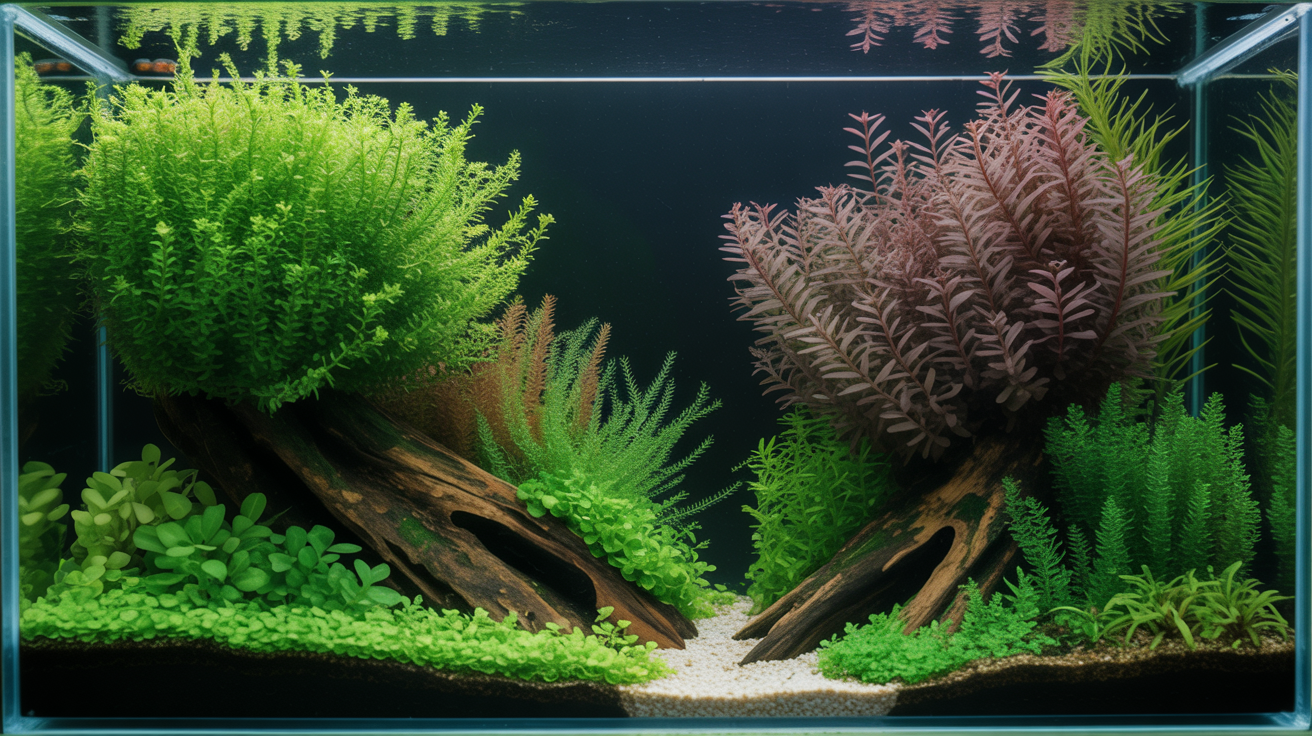
If you want a planted tank but don't want to wrestle with CO2 systems or high-wattage lights, you're in good company. The plants below stay healthy under standard LED or fluorescent lighting (roughly 10–20 PAR at the substrate), grow slowly enough to stay tidy, and forgive the occasional skipped fertilizer dose. This list focuses on species proven across thousands of beginner tanks, not just ones that look good on a store shelf.
Key Takeaways
- All eight plants below grow without CO2 injection under a standard hood light run 8 to 10 hours a day.
- Java fern and anubias attach to hardscape rather than substrate; burying either rhizome will rot it.
- "Melt" and "crypt melt" after planting are normal transition stress, not death; give a new plant 3 to 4 weeks before giving up on it.
- Slow growth is the point. Less trimming, fewer nutrient swings, and far less algae than fast-growing showpiece plants.
- A basic liquid fertilizer at half dose weekly noticeably improves color, even though none of these plants strictly require it.
Why Low-Light Plants Are the Right Starting Point
New aquarists often buy fast-growing, light-hungry plants because they look lush at the shop. Those plants quickly run into trouble in a typical 10- or 20-gallon tank with a basic hood light: they stall, melt, or get outcompeted by algae once nutrients go uneven.
Low-light plants do the opposite. They grow slowly, consume nutrients at a pace that matches the biological load of a lightly stocked tank, and rarely cause the boom-and-bust algae cycles that frustrate beginners. Slower growth also means less frequent trimming, which matters when you're still figuring out the hobby.
The trade-off is patience. A Java fern or anubias might put out two or three new leaves a month. That's fine. Stability is the goal, not spectacle.
The 8 Best Beginner Aquarium Plants
These species have been tested in community tanks, species-only setups, and everything between. Each tolerates a wide pH range (6.5–7.8), temperatures from 72–82°F (22–28°C), and standard LED lighting without CO2 injection.
| Plant | Growth Rate | Placement | Max Size | Notes |
|---|---|---|---|---|
| Java Fern | Slow | Mid / Background | 12 in (30 cm) | Tie to rock or driftwood; roots rot in substrate |
| Anubias Barteri | Very Slow | Foreground / Attached | 8–16 in (20–40 cm) | Rhizome above substrate; algae on leaves = too much light |
| Java Moss | Moderate | Anywhere | Carpet/mat | Hides fry; can grow loose or attached |
| Cryptocoryne Wendtii | Slow | Mid / Foreground | 6–10 in (15–25 cm) | "Crypt melt" on move-in is normal; it recovers |
| Amazon Sword | Moderate | Background | 16–24 in (40–60 cm) | Needs root tabs; large tank (30+ gal) best |
| Hornwort | Fast | Floating / Background | Unlimited | Sheds needles under stress; great nutrient sink |
| Marimo Moss Ball | Very Slow | Bottom / Decoration | 2–5 in (5–12 cm) | Not a true moss; rotate quarterly for round shape |
| Water Wisteria | Moderate | Background | 20 in (50 cm) | Can be planted or left floating; easy propagation |
Java Fern (Microsorum pteropus)
Java fern is practically indestructible. It attaches to rock or driftwood via rhizomes and pulls nutrients through its leaves, not its roots. Burying the rhizome kills it, so tie it with thread or a rubber band until it grips on its own (usually 3–4 weeks). Baby plants (plantlets) sprout on the leaf tips and can be snapped off and attached elsewhere once they're about an inch long.
A common beginner mistake: positioning java fern directly under a bright spotlight. The leaves go brown-spotted and translucent. Move it to a shadier corner and the problem stops.
Anubias Barteri
Anubias is probably the most recommended plant on this list, and for good reason. Its thick, waxy leaves repel most plant-eating fish (a huge plus if you keep cichlids or goldfish), and it genuinely thrives on neglect. Rhizome above the substrate is the single rule. Like java fern, attach it to hardscape.
If green algae coats the leaves, the light is too intense or the photo period is too long. Pull the plant, scrub the leaves gently with a soft toothbrush under running water, and reduce your lights to 8 hours a day. Check your lighting setup against the aquarium lighting guide for plants if you're unsure where to set the timer.
Cryptocoryne Wendtii
Crypts are the gold standard for low-tech foreground and mid-ground planting. Wendtii comes in green, brown, and red varieties and stays compact enough for tanks as small as 10 gallons. The notorious "crypt melt" happens when the plant is moved: leaves go limp and dissolve within a week of transplant. This is normal. Leave the roots in place, keep water quality stable, and new growth will emerge from the same rhizome within 2–4 weeks. Don't pull it out; it isn't dead.
Root tabs placed every 4–6 inches (10–15 cm) in the substrate every 3–4 months will push crypts from "surviving" to "thriving."
Java Moss (Taxiphyllum barbieri)
Java moss is the aquascape workhorse. You can tie it to stones to build a low carpet, drape it over driftwood for a natural look, or leave it floating where it becomes an instant refuge for fry and shrimp. It tolerates temperatures up to about 82°F (28°C) but slows visibly above that. Below 72°F (22°C) it barely grows.
For a moss wall or carpet, attach clumps to mesh or a flat stone and weight it down. Within a month it'll knit itself together. Trim it with scissors to keep it from smothering slower-growing plants underneath.
Hornwort (Ceratophyllum demersum)
Hornwort earns its place by growing fast enough to outcompete algae for nitrates. It's one of the few plants that works as a floating top-layer plant or as a rooted background plant, though it doesn't form true roots. The main complaint is shedding: under poor conditions (sudden temperature swings, low light, hard water above 25 dGH) it sheds fine needles that clog filter intakes. Keep conditions stable and it stays tidy.
It's also allelopathic, meaning it releases compounds that suppress some algae and competing plants. That's great for a monoculture setup; less ideal if you're mixing plant species.
Planting and Anchoring: The Basics
Getting plants to stay put is half the battle for beginners. Rhizome plants like java fern and anubias need hardscape; pushing them into gravel damages or kills them. For substrate plants like crypts and swords, anchoring them correctly from the start saves a lot of replanting later.
A few practical rules:
- Plant stems 2–3 inches (5–7 cm) deep in fine-grain or mixed substrate. Coarse gravel doesn't hold stems.
- Use plant weights or lead strips (sold for this purpose) for floating-prone stems during the first couple of weeks.
- If fish dig, place flat stones around the base of new plantings until roots establish.
- Rhizome plants: use black cotton thread or nylon fishing line to tie to driftwood. The thread degrades harmlessly; the plant grips by then.
Do You Need CO2 or Special Fertilizers?
Short answer: no, for the plants on this list. All eight species listed above can complete their life cycles using the CO2 dissolved naturally in tank water from fish respiration and surface agitation.
That said, a basic liquid fertilizer (one that includes nitrogen, phosphorus, potassium, and micro-elements) added weekly at half the bottle dose will noticeably improve color and growth rate. Plants in a heavily stocked tank may get enough nutrients from fish waste alone. Plants in a lightly stocked tank, especially one with an active protein skimmer or strong surface agitation, often benefit from supplementing.
For a deeper look at whether adding CO2 ever makes sense as your skills grow, the CO2 for planted tanks guide walks through the cost, complexity, and payoff honestly.
Root tabs matter for heavy root feeders (swords, crypts) in inert substrate like plain gravel or sand. Push one tab 2 inches (5 cm) below the plant's root zone and replace every 3–4 months.
Common Problems and How to Fix Them
Yellow or transparent leaves: Usually a nitrogen deficiency in lightly stocked tanks, or too much light causing chlorophyll breakdown. Test nitrate first. If it reads below 5 ppm, add a nitrogen-containing liquid fertilizer. If nitrate is fine, reduce your photo period by an hour.
Brown or black leaf edges: Often a sign of poor water quality. Test ammonia, nitrite, and nitrate. Ammonia above 0.25 ppm or nitrite above 0 ppm will damage plant tissue before it kills fish. A 25–30% water change and a check of the filter media usually corrects this.
Algae covering leaves: Almost always a lighting issue (too intense, too long, or a poor spectrum) combined with low plant biomass. Reduce the photo period to 8 hours, add more fast-growing plants like hornwort or water wisteria, and consider a small clean-up crew (nerite snails, otocinclus catfish in tanks 20 gallons and up).
Plants floating free: Fish disturbing substrate, water current pushing light stems, or roots not yet established. See the anchoring notes above.
Stocking Plants With Fish: Quick Compatibility Notes
Most community fish coexist peacefully with low-light plants, but a few common species will shred or uproot them:
- Goldfish eat nearly everything soft; stick to anubias and java fern (leaves too tough to be palatable).
- Large cichlids often dig. Heavy stones around root zones help; so does choosing plants the fish can't budge.
- Plecos over 6 inches (15 cm) sometimes rasp on broad-leaved plants like anubias. Usually cosmetic damage, not lethal.
- Shrimp are almost universally plant-safe and help by grazing algae off leaves.
Frequently Asked Questions
Can I use aquarium plants in a tank with no special lighting?
It depends on what "no special lighting" means. A bare incandescent bulb from a hardware store won't cut it. Standard aquarium LED strips sold with most starter kits are usually enough for the plants on this list, provided you run them 8–10 hours a day. If the light doesn't list a PAR value, look for one rated at least 20 lumens per liter as a rough starting point for low-light species.
How many plants do I need to start with?
For a 10-gallon (38 L) tank, 3–5 plants of mixed species give good coverage without overcrowding. A 20-gallon (75 L) tank can handle 8–12. You don't need to fill every inch on day one; plants spread, and empty space gives fish room to swim.
Will plants keep my tank clean?
They help, but they aren't a replacement for regular water changes. Plants consume nitrate and compete with algae for nutrients, which stabilizes water chemistry between changes. A well-planted tank often needs slightly less frequent large water changes, but weekly 15–20% changes remain the backbone of good water quality.
My new plant is melting. Should I throw it out?
Almost certainly not. Melt happens when plants transition from emersed (grown above water in nurseries) to submersed conditions. The old leaves die back while new, adapted leaves grow in. As long as the rhizome or root crown looks firm and white or light-colored, the plant is alive. Give it 3–4 weeks in stable water before deciding it's a loss.
Can I keep these plants in a goldfish tank?
Java fern and anubias are your best bets. Their tough, slightly bitter-tasting leaves deter most goldfish from eating them. Everything else on this list risks being nibbled to stumps. Marimo moss balls sometimes survive in goldfish tanks but get torn apart if the fish are bored or hungry.
Further Reading
- Java fern, Leptochilus pteropus (Wikipedia) confirms its native range across Southeast Asia and its natural habit of growing attached to riparian roots and rocks rather than in substrate.
- Anubias barteri (Wikipedia) covers the plant's native range in West Africa and its four recognized varieties, including the compact nana form popular in small tanks.
- Cryptocoryne wendtii (Wikipedia) traces the species back to Sri Lanka and explains why it shows so much color variation between tanks.
- Ceratophyllum demersum, hornwort (Wikipedia) describes the turions (overwintering buds) hornwort forms and its allelopathic effect on competing algae, which lines up with why it's such a useful nutrient sink.