Aquarium Plants
Aquarium Lighting for Plants: How Much and How Long
Learn how much light planted tanks actually need, how long to run aquarium lights, and which PAR values suit low, medium, and high-tech setups.
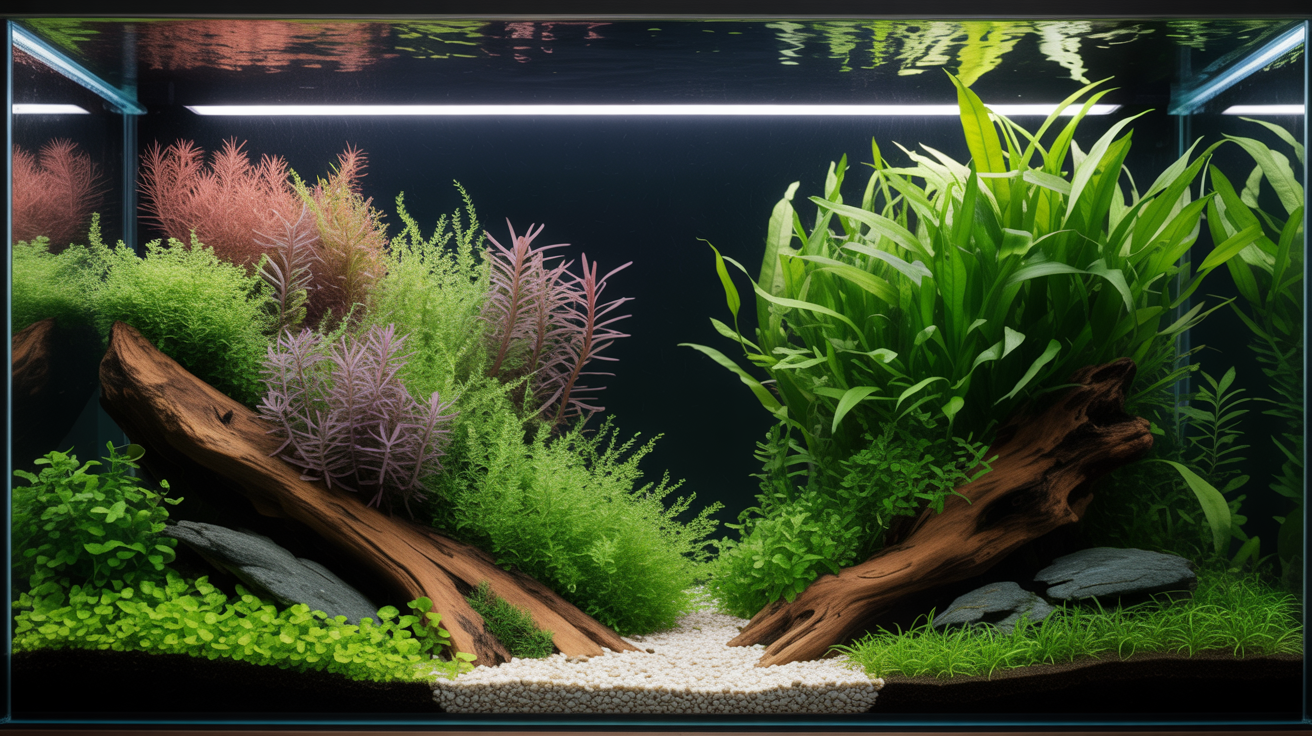
Aquarium plants need light the way land plants need sunlight: the right amount drives healthy growth, and the wrong amount causes algae, pale leaves, or outright plant death. The good news is that most freshwater plants are forgiving once you understand two numbers, PAR (how intense) and photoperiod (how long).
What PAR Actually Means for a Planted Tank
PAR stands for Photosynthetically Active Radiation, the slice of the light spectrum (roughly 400–700 nm) that plants use for photosynthesis. It's measured in micromoles of photons per square meter per second (µmol/m²/s), usually written as just "PAR" on fixtures or in forum shorthand.
You'll sometimes see PPFD (Photosynthetic Photon Flux Density) used interchangeably, both describe intensity at the substrate.
PAR Ranges by Tank Type
| Setup | PAR at Substrate | Typical Plants |
|---|---|---|
| Low-tech, no CO2 | 20–50 µmol/m²/s | Java fern, anubias, most mosses |
| Medium-tech, optional CO2 | 50–100 µmol/m²/s | Crypts, swords, stem plants |
| High-tech, pressurised CO2 | 100–200+ µmol/m²/s | Carpeting plants, stem show tanks |
Most hobbyists start way too high. A beginner tank with anubias and java fern planted under a fixture cranked to 150 µmol/m²/s, with no CO2 and light fertilisation, will grow green water and hair algae rather than plants. Light is the accelerator; CO2 and nutrients are the fuel. If the fuel isn't there, don't floor the accelerator.
If you're growing easy species without injected CO2, you're almost certainly in the 20–50 µmol range. That's legitimately enough to keep plants green and growing. Check how CO2 affects plant growth before pushing PAR higher.
How Long to Run Aquarium Lights
Eight hours is the most reliable starting point for a planted freshwater tank. That matches a tropical day length and keeps algae from getting a foothold.
Specific photoperiod guidelines:
- 6–7 hours, consider this if you're battling established algae or if your tank is near a window with ambient light
- 8 hours, standard for most planted tanks, with or without CO2
- 9–10 hours, suitable for high-tech setups with strong CO2 and regular dosing
- 12+ hours, rarely beneficial, almost always problematic; algae thrive here
Run the light on the same schedule every day using a timer. Consistency matters: plants acclimate to a rhythm, and erratic on/off cycles stress them and open windows for algae blooms.
The Siesta Method
Some hobbyists split the photoperiod into two blocks with a midday break, for example, 4 hours on, 3 hours off, 4 hours on. The idea is that CO2 builds up during the off period and gets used efficiently when the light returns. Results are mixed. If you're having algae problems in a medium-tech tank, a siesta is worth a trial run for 4–6 weeks. For most setups, a straight 8-hour block is simpler and works fine.
Choosing an LED Aquarium Light
LED fixtures have largely replaced fluorescent T5 and T8 tubes for planted tanks, and for good reason: they run cooler, draw less electricity, and can be dialed down with a dimmer so you don't commit to the maximum output.
What to look for:
- PAR data at specific depths, a reliable manufacturer publishes PAR maps, not just lumens or wattage. Lumens measure human-visible brightness; plants don't care about that number.
- Full-spectrum output, you want coverage across the 400–700 nm range, not just red and blue.
- Dimmer control, lets you start low (30–40%) and raise intensity over a few weeks to avoid shocking your tank into an algae cycle.
- Appropriate spread for your footprint, a light designed for a 24-inch tank will leave corners dim on a 36-inch tank.
You don't need the most expensive fixture to grow plants well. A mid-range LED with published PAR data and a dimmer will outperform a cheap, undocumented fixture at double the wattage.
Matching Light to Tank Depth
PAR drops sharply with depth. A fixture that reads 80 µmol/m²/s at 10 inches might read 30 µmol/m²/s at 18 inches. Substrate-level PAR is what matters for carpeting plants. Tall tanks (24 inches or deeper) need more powerful fixtures or fixtures mounted closer to the water surface, which can create heat and evaporation issues.
For deep tanks growing low-light plants, floating plants on the surface to scatter light is a practical trick that reduces intensity at mid-column while keeping surface plants happy.
Low-Light vs. High-Light Plants: Matching the Light to the Plant
Not all aquarium plants want the same light levels, and forcing a high-light regime on low-light species does more harm than good.
Low-light plants (20–50 µmol/m²/s): Anubias, java fern, java moss, hornwort, most crypts. These are excellent starting points for beginners and for tanks with stock community fish. See the full guide to low-light aquarium plants for species selection and planting tips.
Medium-light plants (50–100 µmol/m²/s): Amazon swords, vallisneria, ludwigia species, most stem plants at moderate growth rates. A basic liquid fertiliser and optional CO2 keep these thriving.
High-light plants (100–200+ µmol/m²/s): HC Cuba, dwarf baby tears, most foreground carpeting plants, glossostigma. These genuinely need pressurised CO2 and a complete fertiliser regimen to succeed. Without CO2, high light just feeds algae.
A simple rule: start with lower light and more forgiving species, then upgrade both light and plant selection together once you understand your tank's nutrient balance.
Signs Your Lighting Is Off
Plants communicate clearly when light conditions are wrong:
Too little light:
- Leggy, elongated stems reaching toward the surface
- Yellowing of lower leaves while upper leaves stay green
- Slow or zero growth on stem plants
- Crypts melting and not recovering
Too much light (relative to CO2 and nutrients):
- Green spot algae on slow-growing leaves like anubias
- Hair algae or green thread algae on substrate and hardscape
- Blue-green algae (cyanobacteria) patches, often with a musty smell
- Green water (suspended algae) despite good filtration
Algae alone doesn't confirm excess light, it often signals a nutrient imbalance. But if you're getting heavy algae growth on well-fertilised plants with CO2, trimming your photoperiod by 1–2 hours is the fastest first fix.
Setting Up a Lighting Schedule: A Practical Starting Point
If you're setting up a new planted tank or rebooting a struggling one, this schedule works for most beginner to intermediate setups:
- Start at 6 hours per day for the first two weeks while plants establish roots and adjust.
- Dim the fixture to 40–50% of maximum output regardless of what PAR the fixture claims.
- Watch for plant response: new growth, pearling (oxygen bubbles on leaves during peak hours), and no algae outbreaks are all good signs.
- After two weeks, extend to 7–8 hours if plants look healthy.
- Raise intensity slowly, 10% at a time, only if plants show signs of light hunger (see above).
This slow ramp gives your plants time to establish before algae gets a competitive advantage. Once you find the balance, don't chase higher numbers just because a forum post claims 150+ PAR is necessary. That advice usually comes from high-tech show tanks with pressurised CO2 and daily fertiliser dosing.
Getting plants properly anchored matters too, a plant that floats free of the substrate can't absorb nutrients through its roots efficiently, which changes how it responds to light. Planting and anchoring techniques cover the mechanics.
Frequently Asked Questions
How many hours a day should aquarium lights be on for plants?
Eight hours is the standard starting point for most planted freshwater tanks. Low-tech setups with easy plants can get away with 6–7 hours. High-tech tanks with CO2 injection can run 9–10 hours. Avoid running lights for 12 hours or more, it rarely benefits plants and reliably feeds algae.
What PAR do I need for a planted tank without CO2?
20–50 µmol/m²/s at substrate level is the target for low-tech, no-CO2 tanks. That range supports low-light plants like anubias, java fern, and most crypts without triggering algae blooms. Going higher without CO2 to match will produce algae faster than plant growth.
Can I use a regular LED bulb for aquarium plants?
Standard household LED bulbs are not ideal. They're designed for human vision, not the photosynthetically active spectrum plants use. Some will grow easy low-light plants at close range, but they lack the spread and depth penetration of purpose-built aquarium fixtures. For reliable results, use a fixture with published PAR data and full-spectrum output.
Why is my planted tank getting algae even though I have good lighting?
Algae means the light is outpacing either CO2 or nutrients (or both). Reduce your photoperiod by 1–2 hours first and see if it improves over 2–3 weeks. Also check whether you're dosing a complete fertiliser regularly. High-intensity light without matching CO2 and nutrients is the single most common cause of persistent algae in planted tanks.
How do I measure PAR in my own tank?
A PAR meter (quantum sensor) is the accurate answer, but they cost $200–500 new. Some local fish stores and aquarium clubs loan them out. Alternatively, check published PAR maps from your fixture's manufacturer at the depth of your substrate and treat those numbers as approximations, real-world readings often differ by 15–30% based on water clarity, substrate colour, and fixture position.