Water Quality
How to Test Aquarium Water (and How Often)
Learn how to test aquarium water with liquid kits or test strips, what parameters to check, and how often to test for a healthy freshwater tank.
Testing your aquarium water is the single most useful habit a fishkeeper can build. A five-minute test once or twice a week tells you whether the tank is safe before your fish show any outward signs of stress, and it gives you a baseline to catch problems early.
This guide covers which parameters matter, how to choose between liquid test kits and test strips, step-by-step instructions for both, and a practical schedule for how often to test at each stage of a tank's life.
Which Parameters Actually Matter
Freshwater tanks produce a predictable chain of chemical events. Fish and uneaten food release ammonia; beneficial bacteria convert ammonia to nitrite, then nitrite to nitrate. Those three compounds (plus pH) are the core of every water test.
| Parameter | Safe Range (freshwater) | Why It Matters |
|---|---|---|
| Ammonia (NH3/NH4+) | 0 ppm | Toxic at any detectable level; gill damage begins fast |
| Nitrite (NO2-) | 0 ppm | Blocks oxygen transport in the blood |
| Nitrate (NO3-) | Below 20 ppm (lower for sensitive species) | Accumulates between water changes; stresses fish long-term |
| pH | 6.5–7.5 for most community fish | Affects gill function and nitrogen chemistry |
Two additional parameters are worth testing periodically:
- KH (carbonate hardness): buffers pH against sudden drops. A KH below 3 dKH makes pH unstable, especially in planted tanks with active CO2 uptake.
- GH (general hardness): reflects dissolved calcium and magnesium. Relevant for softwater species (discus, cardinal tetras) or hardwater species (African cichlids, livebearers).
Temperature is technically not a chemical parameter, but a reliable thermometer is just as essential, most tropical fish need 74–80°F (23–27°C). For a deeper look at what the numbers mean, see ammonia, nitrite, and nitrate explained.
Liquid Test Kits vs. Test Strips
This is the most common question beginners ask, and the answer is fairly clear-cut once you understand the trade-offs.
Liquid Test Kits
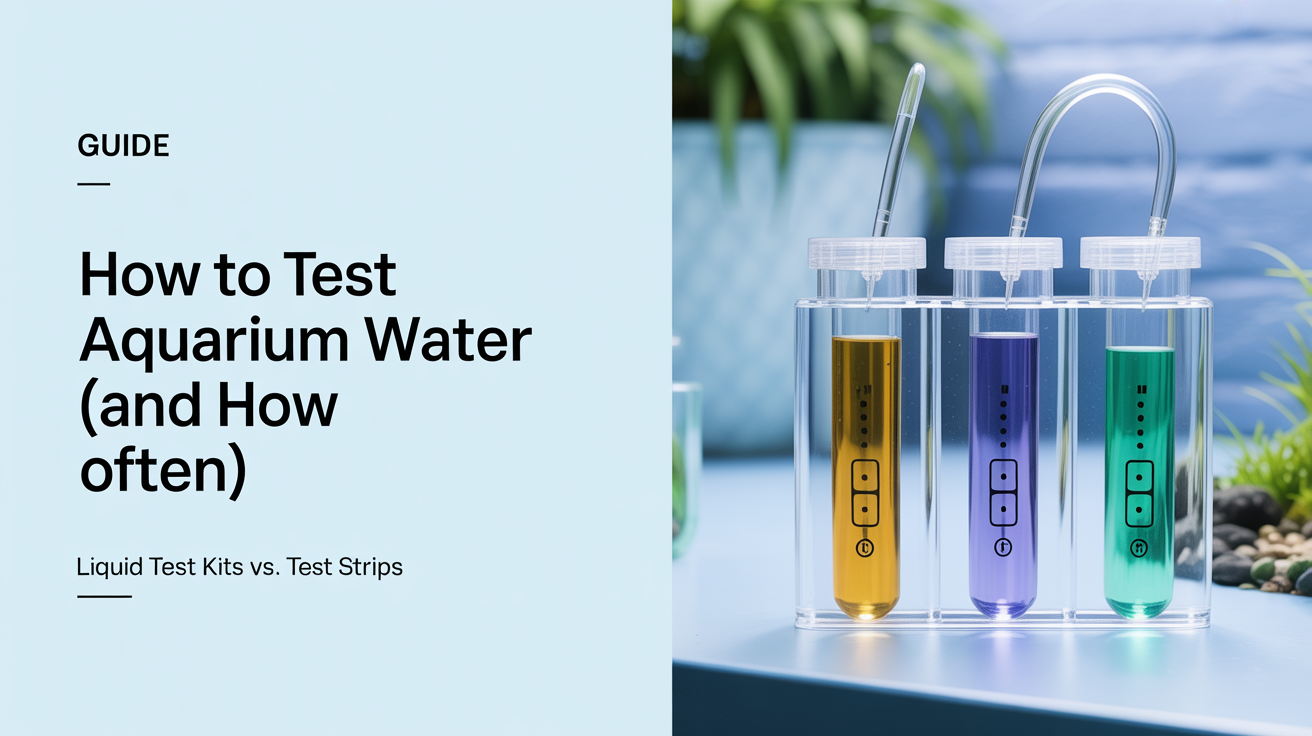
Liquid kits use reagent drops added to a small water sample in a glass vial. You compare the resulting color to a printed chart under natural or incandescent light (never fluorescent, it skews the result).
Pros:
- More accurate than strips, especially at low ammonia and nitrite concentrations
- Vials and reagents last 18–24 months when stored correctly (away from heat and direct light)
- Individual reagents can be replaced as they run out
Cons:
- Takes 5–10 minutes to complete a full panel
- Requires rinsing vials after every use
- Slightly more expensive upfront
A standard liquid master kit covers ammonia, nitrite, nitrate, and pH. Most experienced hobbyists keep one on hand and consider it a permanent part of their equipment.
Test Strips
Strips dip directly into the tank or a sample cup. Most multi-parameter strips measure five or six values in about 60 seconds.
Pros:
- Very fast, useful for a quick sanity check
- No equipment to clean
- Good for travel or a second tank where you just want a rough pass
Cons:
- Less accurate, especially for ammonia and nitrite at low concentrations
- The colorimetric pads can fade after the container is opened; use within six months
- Simultaneous readings on adjacent pads can bleed color into each other
If you're cycling a new tank or troubleshooting a sick fish, use a liquid kit. Strips are fine for routine checks once you know a tank is stable and you're mostly watching for nitrate creep.
How to Test with a Liquid Kit (Step by Step)
- Rinse the test vial with tank water twice, then fill to the marked line (usually 5 mL).
- Add the specified number of drops from each reagent bottle. Tap the cap firmly between uses so no residue drips onto the bottle threads.
- Cap the vial and invert or shake per the kit's instructions. The ammonia and nitrite tests often need 5 minutes to develop fully.
- Hold the vial against the color chart in natural daylight. Read from the side, not the top.
- Record the result. A simple notebook or a notes app works fine, you'll want the history later.
- Rinse vials thoroughly with tap water and let them air-dry before storing.
Common mistake: skipping the shake time. An underdeveloped color reads low, which can hide a real ammonia or nitrite spike.
How to Test with Test Strips
- Pull a single strip from the container and reseal the cap immediately (moisture degrades the pads).
- Dip the strip in tank water for one second; don't wave it around.
- Hold the strip level and start a timer. Most strips read at 60 seconds; check your brand's chart for exact timing.
- Compare each pad to the chart under natural light. Read the pads in the sequence shown on the chart, some results shift color over time.
Do not dip the strip in the tank itself if you have small fish, the colorimetric dyes can be irritating in concentrated form. Use a small cup of tank water instead.
How Often to Test Your Aquarium Water
The right testing frequency depends on where your tank is in its life cycle.
New Tank (Cycling Phase): Daily or Every Other Day
A new tank has no established bacterial colony, so ammonia can spike rapidly. Test ammonia and nitrite every day or every other day from day one until both read 0 ppm for at least a week straight. Understanding the full nitrogen cycle first makes these numbers much easier to interpret, aquarium water parameters explained for beginners is a good primer.
Established Tank: Twice a Week
Once cycling is complete, twice-weekly tests catch problems before they become crises. Test ammonia and nitrite to confirm they're still holding at 0 ppm, and track nitrate to time your water changes.
Stable, Well-Maintained Tank: Weekly
After six months or so with consistent numbers, many experienced keepers drop to once a week. The key word is consistent, if you add new fish, change your feeding amount, or see any behavioral oddities, bump back up to twice weekly until things settle.
After Adding Fish or Plants: Daily for One Week
Any significant bioload change (adding several new fish, removing a large plant mass, or moving substrate) can temporarily destabilize the nitrogen cycle. Test daily for seven days after the addition.
When Something Looks Wrong: Immediately
If a fish is gasping at the surface, flashing against decorations, or behaving lethargically, test water before trying anything else. Medication and temperature changes are stressful on top of a water quality problem, and you can't choose the right response without knowing what you're dealing with. For anything beyond a routine water quality correction, talk to an aquatic vet or an experienced local fish store.
Reading Results and What to Do Next
- Ammonia or nitrite above 0 ppm: Do a partial water change right away, 25–30% is a reasonable starting point. For guidance on how to do that correctly, see how to do an aquarium water change the right way. Test again in 24 hours.
- Nitrate above 20 ppm: Schedule a water change sooner than usual. Most tanks need 25–30% weekly to keep nitrate in a safe range; heavily stocked tanks may need more.
- pH below 6.4 or above 8.0: Investigate the cause before adjusting. Sudden pH swings are more harmful than a stable reading outside the "ideal" range. Check KH first, low buffering capacity is usually the root cause.
- All zeros, normal pH: The tank is in good shape. Record the numbers and test again on schedule.
Keeping a simple log pays off over time. When something does go wrong, a few months of normal readings makes it much easier to spot what changed.
Frequently Asked Questions
Can I test my aquarium water with fish in it, or do I need a separate sample?
You can test directly from the tank using a turkey baster or dedicated sample cup. Avoid dipping test vials directly into the tank repeatedly because this introduces reagent residue. Collect a 5–10 mL sample first, then test from that.
My test kit reads 0 ppm for everything but my fish look stressed. What could be wrong?
Check temperature first, a heater failure or a faulty thermometer is a common culprit. If temperature is fine, test pH and KH. Dissolved oxygen is another possibility; surface agitation from the filter outflow is usually sufficient for most setups, but a large plant dieback or a heat spike can drop O2 quickly. If symptoms persist and parameters look normal, consult an aquatic vet or a knowledgeable local fish store.
How long do liquid test kit reagents last?
Most manufacturers rate their reagents at 18–24 months from the manufacture date printed on the bottle (not the purchase date). Store them at room temperature away from direct sunlight. High or low storage temperatures shorten shelf life. If a reagent has been open for more than two years, replace it before trusting the results.
Are there digital water testers worth buying?
Digital testers exist for pH and TDS (total dissolved solids), and a good pH meter is genuinely more accurate than a liquid test's color comparison. TDS meters are useful for RO/DI water, but TDS itself doesn't tell you what's dissolved, it doesn't distinguish nitrate from calcium. For the full nitrogen cycle picture, you still need a liquid kit or strips. A pH meter plus a liquid kit is a solid combination for serious hobbyists.
How do I know if my test strips have gone bad?
Expired or moisture-damaged strips often produce readings at the very high or very low end of every parameter simultaneously, or the color pads won't develop at all after the recommended wait time. When in doubt, cross-check with a liquid kit. If you've had the strip container open for more than six months, replace it.